
How edge-glued furniture panels are made
An edge-glued panel looks simple — a flat surface made of several joined lamellas — but behind it lies a series of precise steps. The aim is to turn solid wood into a panel that is more stable than a single wide piece, while keeping the look and feel of real timber.
It all starts with kiln-dried wood at 8–10% moisture. The boards are first sorted by colour and features, because it is the face appearance that defines the grade — a calm, even face for A grade, or more natural character for B grade. Already at this stage we allocate material for the required combination (A/A, A/B or B/B).
Next comes cutting and defecting. Knots, cracks and resin pockets are removed, and sound pieces are joined lengthwise by finger joints where needed. This produces either continuous lamellas (with no visible joints) or finger-jointed lamellas, depending on specification and price.
The lamella edges are planed and jointed to be perfectly flat and square — without that there is no clean, strong bond. Glue is applied to the edges (usually PVAc class D3, or D4 where higher moisture resistance is required), the lamellas are laid up by colour and pressed edgewise until the glue cures. This turns separate lamellas into one panel.
The glued panel then goes to calibration and sanding. Wide-belt sanders remove material from both faces until the exact, uniform thickness is reached — in our case within a ±0.2 mm tolerance — and a smooth, ready surface is achieved. Finally the panel is cut to size, up to 1250 × 4000 mm.
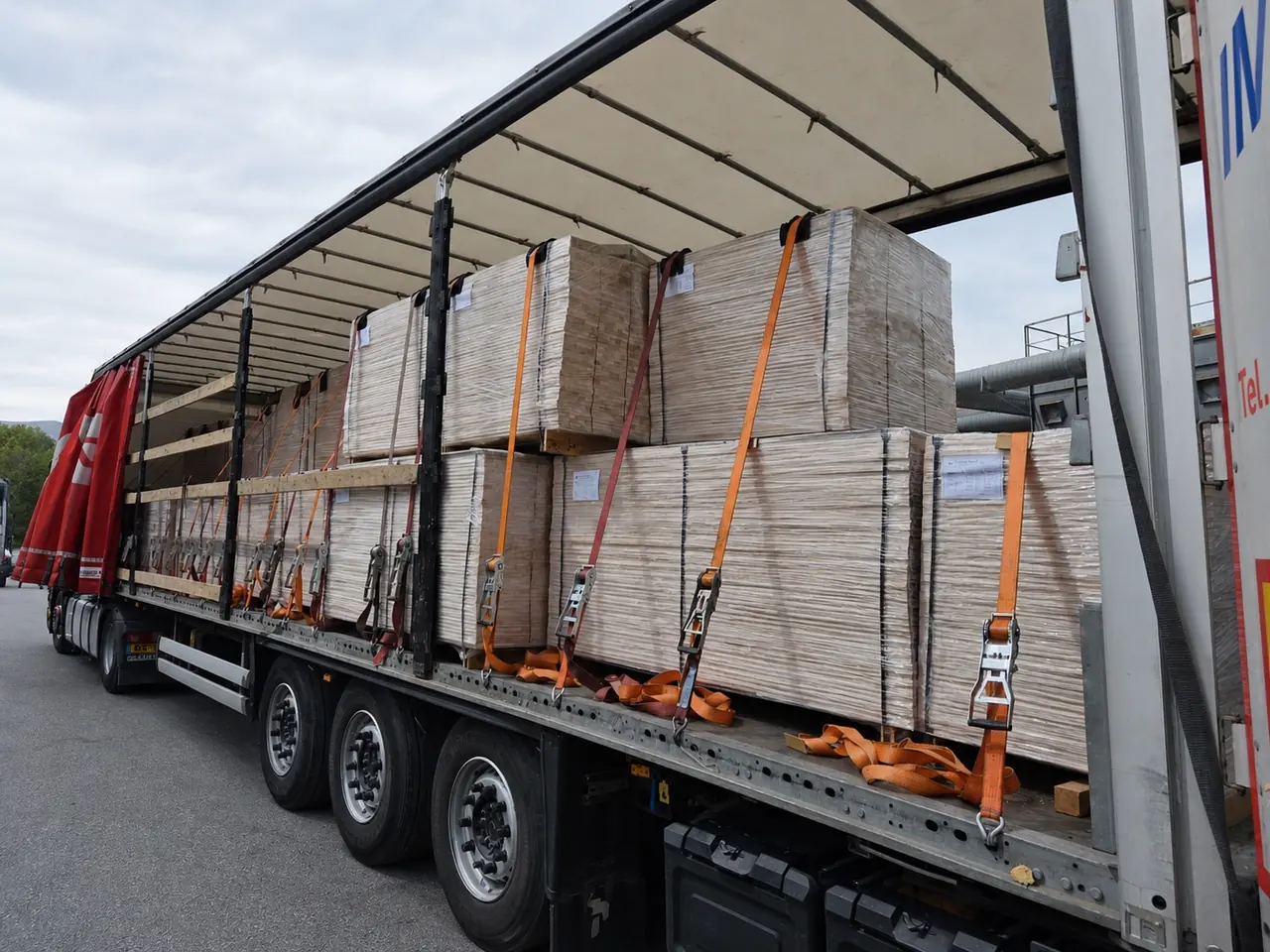
Before packing, the glue joints, thickness and moisture are checked, and the panels are foil-wrapped onto pallets with edge protection. The result is a panel that arrives flat, calibrated and ready to use — the furniture maker can cut and machine it straight away, with no extra fettling.
The greatest advantage of an edge-glued panel is that it combines the best of two worlds: the stability of engineered boards and the authenticity of solid wood. Unlike a single wide board, which cups and warps over time, lamellas with opposing grain keep the panel flat. And unlike chipboard or MDF, this is real wood — it can be sanded, refinished, lacquered and repaired locally, and it has the look and warmth of solid timber. On top of that, narrower and cheaper boards yield large surfaces up to 1250 × 4000 mm that a single piece cannot deliver.
This is why an edge-glued panel is the best choice for series furniture production: better raw-material yield lowers the price, stability reduces complaints, and consistent thickness and flatness cut rework at the customer. You get a material that looks like solid wood, behaves better than solid wood and arrives ready to work — the combination buyers look for precisely because it saves money and raises the quality of the finished product at the same time.